

AEMHY develops high-performance anion exchange membranes (AEM) and matching ionomers in house for anion exchange membrane water electrolysis (AEMWE), fuel cells and electrochemical energy conversion. The membrane and the ionomer come from the same polymer family and are designed as a matched set, so they work together with AEMHY catalysts and electrodes inside the same membrane electrode assembly.
Key Features and Specifications
| Property | Typical value | Why it matters |
|---|---|---|
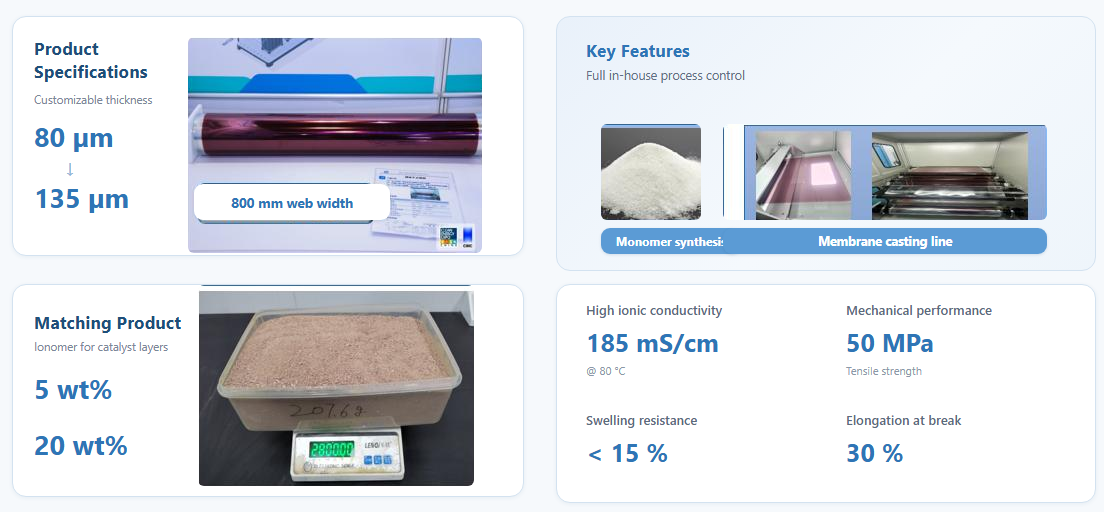
| Hydroxide conductivity | 185 mS/cm at 80 °C | Supports high current density operation with low ohmic loss |
| Tensile strength | 50 MPa | Allows coating processing and large-area electrode fabrication |
| Swelling ratio | Below 15 % | Low dimensional change for long-term stable operation |
| Elongation at break | 30 % | Flexible membrane that resists cracking during assembly and cycling |
| Thickness | 80 to 135 µm (custom thickness available) | Balances ionic resistance and gas barrier for each cell design |
| Maximum roll width | 800 mm | Fits large-area MEAs and multi-cell cutting patterns |
| Matching ionomer solutions | 5 wt% and 20 wt% | Binder and hydroxide conducting phase in the catalyst layers |
In short, the AEMHY anion exchange membrane delivers 185 mS/cm hydroxide conductivity at 80 °C, 50 MPa tensile strength, below 15 % swelling and 30 % elongation at break, with a standard thickness range of 80 to 135 µm, a maximum roll width of 800 mm and matching ionomer solutions at 5 wt% and 20 wt%.
Applications
Anion exchange membrane water electrolysis (AEMWE)
Fuel cells
Electrochemical energy conversion and storage devices
Product Image
FAQ
What is the difference between an anion exchange membrane and an ionomer?
The anion exchange membrane is the solid separator that conducts hydroxide ions between the anode and the cathode while limiting gas crossover. The ionomer is the same family of polymer supplied in solution form; it acts as the binder and the ion conducting phase inside the catalyst layers of the membrane electrode assembly.
What is the conductivity of the AEMHY anion exchange membrane?
The AEMHY anion exchange membrane delivers a hydroxide conductivity of 185 mS/cm at 80 °C, with a tensile strength of 50 MPa, a swelling ratio below 15 % and an elongation at break of 30 %. The standard thickness range is 80 to 135 µm and the maximum roll width is 800 mm. Contact us for selection support and custom thickness.
Can AEMHY membranes be used with non-precious-metal catalysts?
Yes. AEM water electrolysis runs in an alkaline environment, so the membrane is designed to work with nickel and iron based catalysts rather than iridium and platinum, which is what makes AEM electrolysis a lower cost route to green hydrogen than PEM.
Ordering
Membranes and ionomers can be ordered through the company store. Please use the Contact Us page to request the purchase link, detailed specifications and a quotation. Custom thickness, width and ionomer concentration are available on request.