

Design Choices in AEM Water Electrolysis · Part 1
Why AEMHY chooses anode-only feed
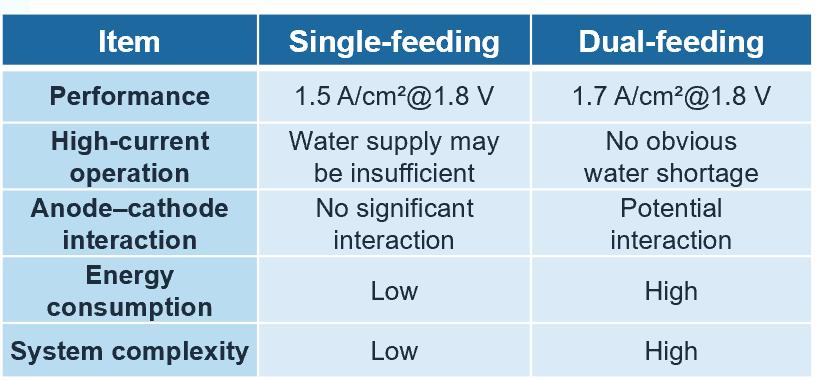
In the comparison presented by AEMHY, dual feed delivered 1.7 A/cm² at 1.8 V, compared with 1.5 A/cm² for anode-only feed. That difference matters when sizing the active area. For a stack intended for long service, we also consider electrode durability and the cost and complexity of circulating the electrolyte.
How water reaches the cathode
The hydrogen evolution reaction at the cathode, 2H₂O + 2e⁻ → H₂ + 2OH⁻, consumes water. With anode-only feed, water reaches the reaction sites through the membrane. As current density increases, so does water demand per unit area. Adequate average water transport can still leave parts of a large cell short of water. The design therefore depends on enough water reaching the entire cathode active area at the intended load.
Matching the feed to the electrodes
In a sprayed cathode, an ionomer provides ionic pathways and helps bind the catalyst layer. Exposure to circulating alkaline electrolyte can cause the ionomer to swell and may weaken the catalyst layer, depending on its formulation and structure. Feeding only the anode avoids direct exposure of the cathode to circulating electrolyte. On the wetted side, AEMHY uses a self-supporting anode with no ionomer binder. This removes one binder-related degradation mechanism from the anode and supports longer electrode life.
Balancing two electrolyte circuits
Dual feed requires control of liquid levels and alkali concentrations on both sides. If net water transport causes water to accumulate in the cathode loop, the liquid level can rise and the electrolyte can become diluted. A liquid connection between the bottoms of the two gas–liquid separators is one way to balance levels and concentrations. The direction and extent of any drift depend on membrane transport and how make-up water and liquid withdrawal are managed.
What can travel with the electrolyte?
When the streams mix, shed particles or dissolved metals from one electrode may reach the other. Their effect on activity and lifetime needs to be evaluated for each catalyst pair. A second liquid circuit also adds piping, level control and maintenance costs. AEMHY favours anode-only feed when the membrane can supply enough water across the cathode at full load.