

China’s expanding hydrogen market presents opportunities for international equipment manufacturers, system integrators and project developers. For buyers evaluating electrolyzers, however, market growth is only the starting point. Technology selection requires a clear understanding of operating conditions, reliability evidence and the scope of supply.
China’s National Energy Administration published the China Hydrogen Development Report (2026) on August 11, 2026. This article highlights selected findings and presents AEMHY’s perspective on their implications for hydrogen equipment procurement.
Key findings from the report
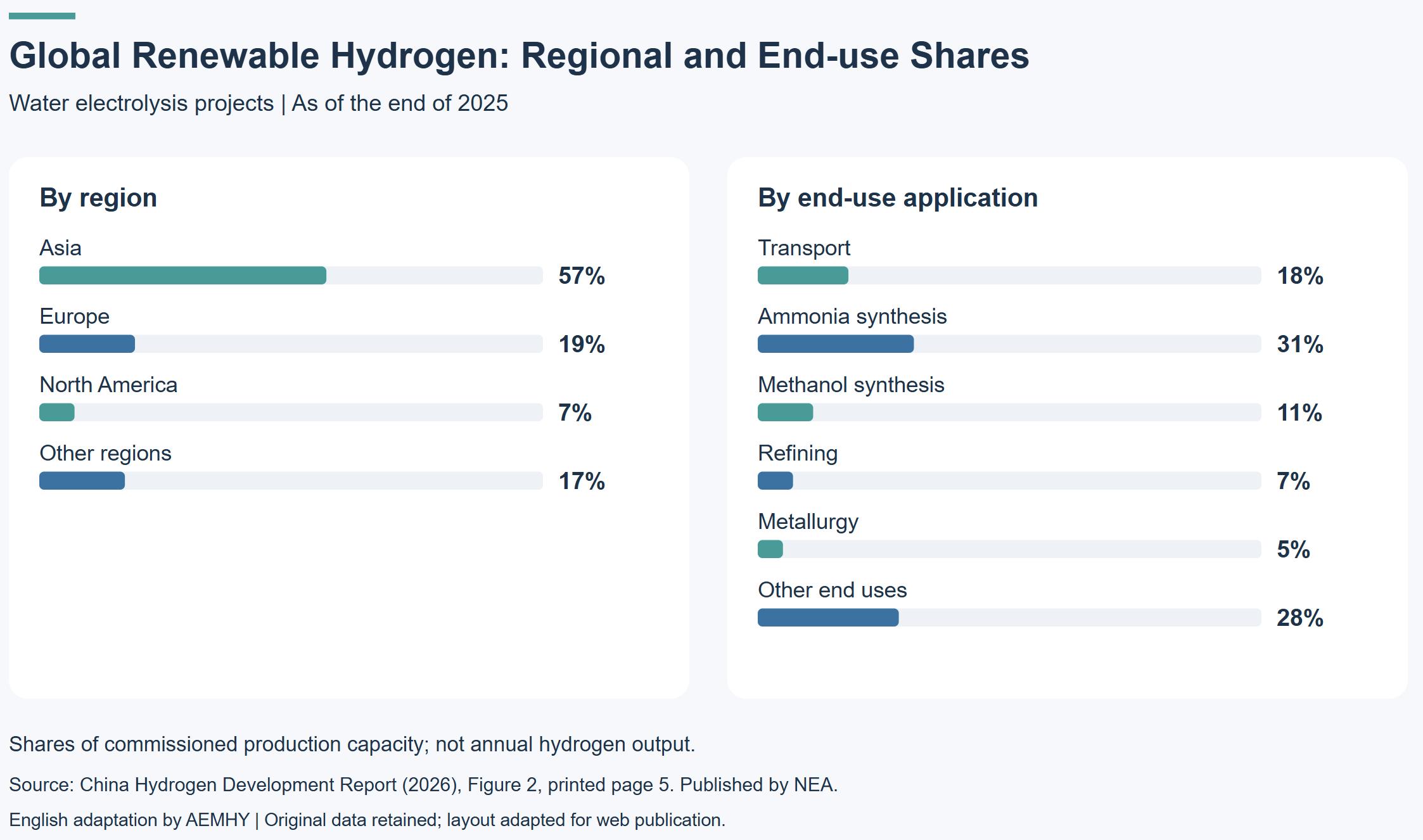
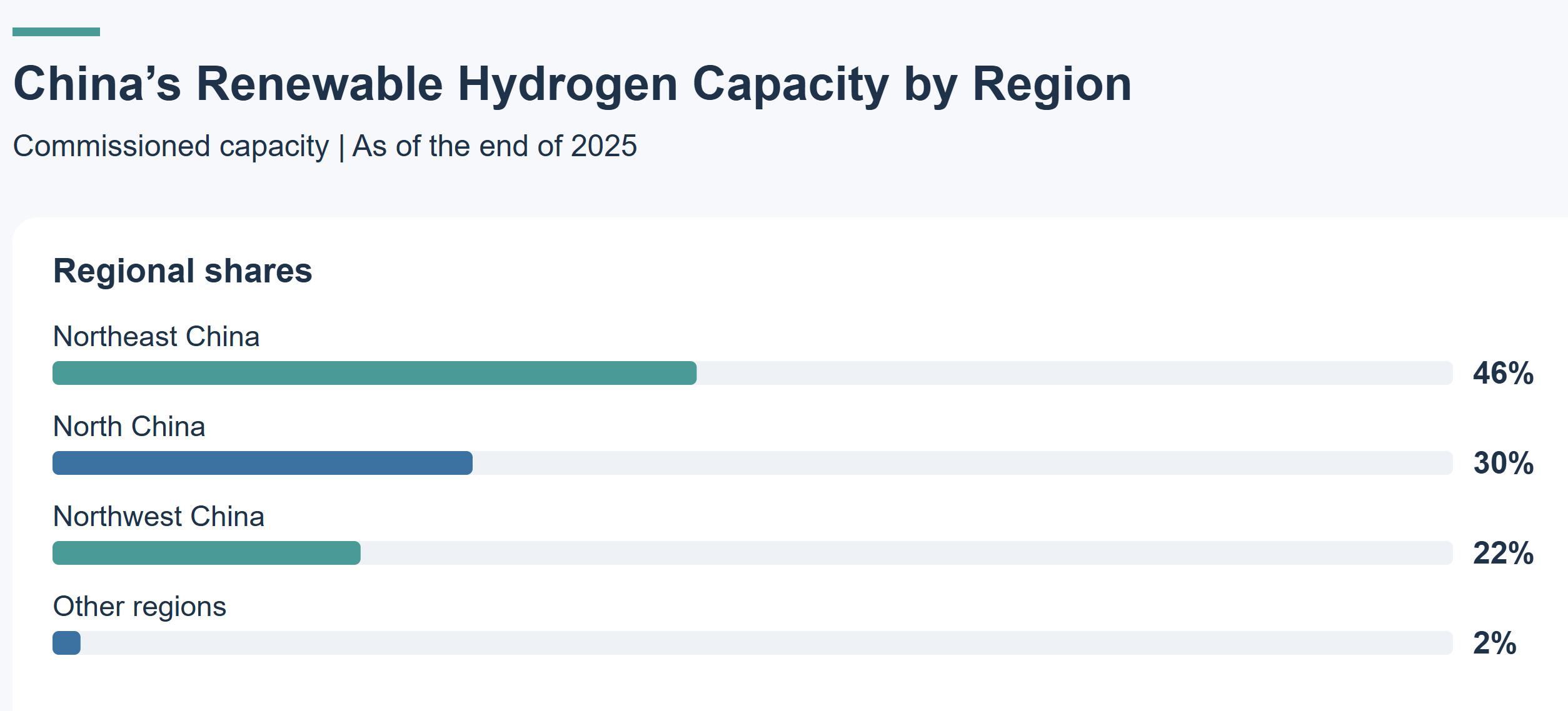
The report records more than 250,000 tonnes per year of commissioned renewable hydrogen production capacity in China by the end of 2025—more than double the level at the end of 2024. Capacity under construction exceeded 900,000 tonnes per year.
It also reports successful trial operation of a megawatt-scale anion exchange membrane electrolyzer. Alongside these developments, it identifies continuing challenges in electricity–hydrogen coordination, demand development, regional infrastructure and advanced materials.
These figures describe production capacity, rather than actual annual hydrogen output. They also distinguish commissioned facilities from projects still under construction.
Source: China Hydrogen Development Report (2026), published by the National Energy Administration, printed pages 12, 16 and 18.
AEMHY’s perspective: Start with the hydrogen application
For a project developer, a useful first question is: what hydrogen supply does the application actually require?
A continuous industrial process, a renewable-powered demonstration and a research installation can have very different requirements. Before comparing equipment quotations, buyers should define:
Required hydrogen output and daily demand profile.
Delivery pressure, purity and acceptable impurity levels.
Electricity availability and expected operating hours.
Available water supply and treatment requirements.
Installation conditions and maintenance arrangements.
These inputs help suppliers propose a configuration that can be evaluated against the project’s actual needs.
Assess AEM technology through model-specific evidence
The report’s reference to megawatt-scale AEM trial operation is an engineering milestone. It does not, by itself, establish the service life, efficiency or commercial readiness of every AEM product.
AEMHY recommends evaluating each proposed stack or system through its own supporting evidence. Buyers should ask whether a performance result relates to a material sample, a single cell, a stack or a complete hydrogen production system.
For durability claims, request the test duration, current density, temperature, pressure, electrolyte conditions and operating profile. Replacement records and voltage degradation data are also important.
A laboratory endurance result and a customer-site operating record answer different questions. Both can be useful when their scope and limitations are clearly documented.
Compare energy consumption on the same basis
An energy-consumption figure is useful only when its measurement boundary is clear.
When reviewing quotations, ask whether the stated value covers the DC stack alone or the complete AC-powered system. Confirm whether it includes water treatment, cooling, gas drying, purification and compression.
Also check the hydrogen delivery pressure, load point and reference conditions used for the stated output.
AEMHY’s recommendation is to compare suppliers against one agreed specification. This helps prevent an apparently lower consumption figure from reflecting a narrower equipment boundary.
Clarify the scope of supply
International cooperation can involve materials, electrodes, membrane electrode assemblies, stacks or integrated systems. These are different purchasing decisions.
Before placing an order, define who is responsible for power conversion, water treatment, thermal management, gas processing, controls, installation and commissioning.
For component procurement, agree on interfaces and acceptance tests. For a complete system, establish the delivery conditions, performance verification procedure and service responsibilities.
A clearly defined scope makes technical discussions more productive and reduces uncertainty during integration.
Connect technology evaluation with a practical next step
For companies exploring AEM water electrolysis, an initial discussion should identify the application, required hydrogen capacity, pressure, electricity profile and intended scope of supply.
From there, the evaluation can progress to configuration selection, technical documentation and agreed validation requirements. This creates a more useful basis for cooperation than comparing headline specifications alone.
About AEMHY
AEMHY is the international brand of Changzhou AEMHY Hydrogen Energy Technology Co., Ltd. (常州市氢舟能源科技有限公司). The company focuses on anion exchange membrane water electrolysis, with work spanning catalysts, membranes and ionomers, electrodes, membrane electrode assemblies, electrolyzer stacks and hydrogen production systems.
To discuss AEM components, stack integration or a hydrogen production application, contact AEMHY. Please include your target hydrogen output, delivery pressure, power supply and intended application so that the discussion can focus on your project requirements.
This article is an independent industry commentary by AEMHY, not an official translation of the report. References to the report do not imply government endorsement of AEMHY or its products.