

When gas crossover is discussed in AEM electrolyzers, the first focus is usually placed on membrane selectivity and gas-barrier performance. These properties are fundamental to hydrogen purity, but in a multi-cell electrolyzer, gas quality is not determined by the membrane alone. It is the combined result of materials, MEA design, stack architecture, fluid management and operating control.
In our recent testing, an AEM electrolyzer operated at approximately 20 Nm³/h of hydrogen production. At a current density of 1.3 A/cm², the system maintained hydrogen in oxygen below 5,000 ppm over 1,000 hours of operation. This result shows that long-term gas quality must be designed and validated at the system level.
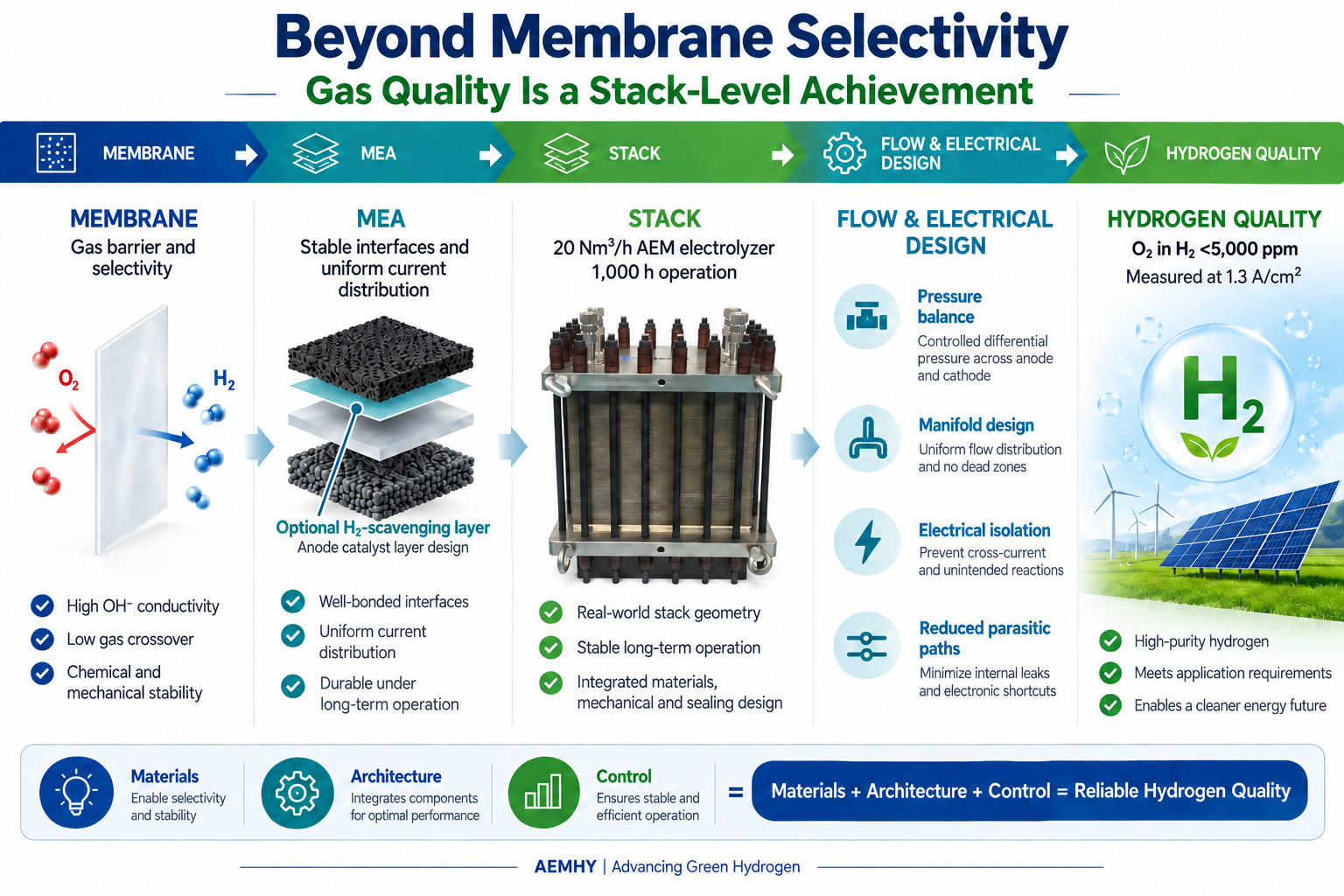
The membrane must provide good gas selectivity, hydroxide-ion conductivity and long-term chemical stability. At the same time, the catalyst layers, ionomer distribution and interfaces within the MEA influence current distribution, gas transport and durability.
Depending on the MEA and stack architecture, an optional hydrogen-scavenging or recombination function may also be considered in the anode catalyst layer. Such a layer can help reduce the impact of residual or crossover hydrogen under defined operating conditions. However, its suitability must be evaluated together with the catalyst system, local gas composition, temperature, pressure and long-term stability. It should be treated as part of an integrated design, rather than as a standalone solution.
Multi-cell stacks also require careful attention to shunt current. Shared manifolds, flow channels and conductive components in contact with the electrolyte can create unintended electrical paths. These paths may generate parasitic currents and unintended electrochemical reactions, increasing the risk of gas cross-contamination.
For this reason, AEM stack design should consider:
membrane selectivity and durability;
MEA interface stability and current distribution;
optional hydrogen-scavenging functionality on the anode side;
pressure balance between the anode and cathode;
manifold and flow-field geometry;
electrical isolation of wetted conductive components;
electrolyte concentration and operating temperature;
sealing quality, assembly consistency and long-term control.
It is also important to recognize that every design choice involves trade-offs. Lowering electrolyte conductivity, changing operating pressure or adding a functional layer may affect efficiency, hydrogen production, cost or lifetime. The objective is not to optimize one parameter in isolation, but to establish a balanced operating window for purity, efficiency, durability and safety.
Therefore, low hydrogen in oxygen should not be viewed simply as evidence of good membrane performance. It is a reflection of how effectively materials, MEA design, stack architecture, electrical isolation, fluid management and control strategies work together.
For commercial green hydrogen projects, customers need more than good initial gas purity. They need predictable, repeatable hydrogen quality that remains stable over long operating periods. This is one of the key challenges AEM electrolyzers must address as the technology moves from laboratory development toward industrial deployment.